
If you run a local business, recent changes in local Google SEO may actually be working in your favor. Over the past month, Google has quietly adjusted how it ranks search results. Map listings are appearing more often. Business profiles are carrying more weight. And websites that clearly show real experience and defined service areas are gaining visibility over generic national sites.
For small and mid-sized businesses, this means you no longer need to compete with the entire internet. You just need to be clear, consistent, and specific about what you do and where you work.
More Searches Are Being Treated as Local
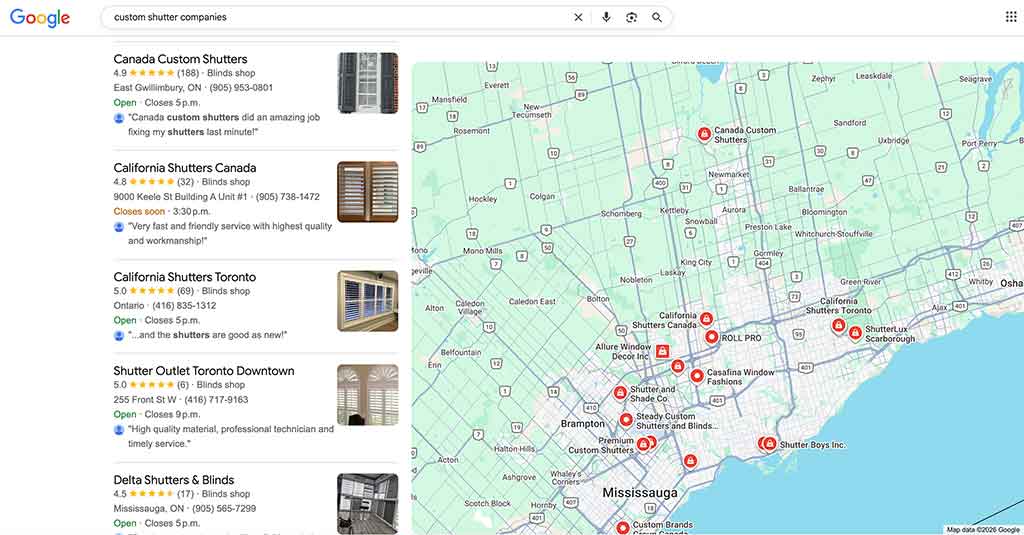
Google is increasingly assuming local intent. Even when someone doesn’t type a city name, Google often displays map listings and nearby businesses first.
This benefits companies that clearly define their service areas.
To strengthen your local Google SEO:
- List specific cities and regions you serve
- Use consistent location wording across your site
- Avoid vague phrases like “serving everywhere”
- Add location context naturally within your content
Clarity helps Google understand relevance.
Google Business Profiles Carry More Ranking Influence
Your Google Business Profile now plays a stronger role in organic visibility. Google cross-checks information between your website and your profile.
Inconsistent details weaken trust. Alignment strengthens it.
Review the following:
- Primary and secondary categories
- Service descriptions
- Business name formatting
- Address and phone consistency
- Review content and keywords mentioned naturally
When your profile and website match, your credibility improves.
Experience Is a Clear Ranking Factor
Google is favouring businesses that show real-world experience. Pages that include specific examples and proof tend to hold rankings better than generic content.
Strong signals include:
- Real project photos
- Clear explanations of your process
- Straightforward answers to common questions
- Local references that show familiarity with your region
You don’t need long articles. You need proof that you actually do the work.
AI Search Prefers Clear, Practical Answers
AI-generated summaries are becoming more common in Google results. These summaries often pull from pages that give direct, easy-to-understand answers.
To improve visibility:
- Answer common customer questions clearly
- Avoid marketing-heavy language
- Use simple explanations
- Focus on practical information like cost, timing, or expectations
Clear content is easier for Google to reference.
Thin Location Pages Are Losing Strength
Location pages still work, but only when they offer real value.
Pages that simply swap city names without adding useful detail are less stable. Pages that include real context perform better.
If you create location pages, make sure they:
- Reference local conditions or common issues
- Include specific examples when possible
- Add meaningful information beyond the city name
Quality now matters more than quantity.

What Website Owners Should Do Now
The recent changes in local Google SEO do not require technical tricks. They require consistency and clarity.
Start here:
- Define your service areas clearly
- Align your website and Google Business Profile
- Add real proof of experience
- Improve or remove thin content
- Answer real customer questions in plain language
Google is rewarding businesses that look real, consistent, and trustworthy. That shift benefits local companies that show who they are and what they actually do.
And that’s the opportunity.
Not Sure Where Your Website Stands?
Google is rewarding businesses that are clear, consistent, and grounded in the areas they serve. If you’re not sure whether your website reflects that, it may be time for a revie
I offer a free website audit focused specifically on local Google SEO signals. No pressure. Just a practical breakdown of what’s working and what could be improved. Click here for your FREE AUDIT

0 Comments